
Category: Museum

  • Bell & Howell Filmosound 8 – Super 8 sound film from 1969 that uses audio cassettes

    Step back into late-60s filmmaking tech with a look at the Bell & Howell Filmosound 8 system, first introduced in December 1969. Long before Kodak’s 1973 launch of factory-striped Super 8 sound film, Filmosound 8 gave filmmakers a way to record true sync sound using completely silent Super 8 cartridges.

    In this video, we show how the Filmosound setup works:

    • A Super 8 camera (like the Bell & Howell Autoload models, and later modified Canon 814s) is tethered to a
    • Dedicated cassette recorder, which captures both the audio and a stream of sync pulses—one pulse for each frame the camera exposes.

    On playback, a matching Filmosound 8 projector reads those pulses from the cassette and constantly adjusts its speed to stay locked to the sound. The film itself has no magnetic stripe—it’s standard Super 8—but the cassette’s pilot-tone track keeps picture and sound perfectly in step.

    That means Filmosound 8 brought sync dialogue and narration to home, educational, and industrial Super 8 productions about four years before Kodak’s own Super 8 sound cartridges (Ektasound) put magnetic stripe directly on the film in 1973.

    You’ll also see why Filmosound never became a true mass-market hit: the setup was a bit cumbersome. You had a camera tethered to a cassette deck, extra cables to wrangle, and then a matching projector to play it all back in sync. But that complexity came with a payoff—because the sound lived on a full-size audio cassette instead of a tiny magnetic stripe on the film (like Kodak’s Ektasound cartridges introduced in 1973), the audio fidelity could actually be better. Less hiss, more headroom, and the option to re-record or mix on tape meant Filmosound 8 sometimes delivered cleaner, richer sound than the “all-in-one” striped Super 8 systems that came later.

    If you’re into vintage cameras, film transfer work, or just love obscure movie tech, this is a great example of how clever engineers worked around the limitations of early Super 8 to get professional-style sound on a consumer format.
  • 1998 Sony Handycam HandyGuide with introduction to Digital Mavica

    Learn some tips & tricks for using your camcorder in 1998. And stay until the end to see the Digital Mavica that records photographs to floppy disks! We digitized this 1998 Video8 cassette to show the equipment and techniques that were available at the time for producing home videos and digital photos. One of our customers still had it in his camera bag with his Sony CCD-TR416 camcorder! Video preservation by DDVF.com for educational purposes.

  • 98 VHS video cassettes

    98 different VHS video tapes from Konica, 3M, AMPEX, Target, PDMagnetics, Focal, Zenith, Spartan, Avanti, Polaroid, Gemini, Digitech, Memorex, Radio Shack, Panasonic, JVC, RCA, Fuji, Scotch, TDK, BASF, Sony, Maxell, and Kodak.

  • Sharp VL-AH150 View Cam Hi8 camcorder

    This is the Sharp VL-AH150 View Cam Hi8 camcorder. It’s got this cool swivel. You can swivel this up and down and still look at the screen.

    Takes Hi8 tapes.

    Start and stop the recording up here. Switch to VCR mode like this to play back tapes. You’ll load the tapes by opening this hatch up.

    That pops open. Put your tape in. Close it.

    And there you have it. This is probably from the 2000s.

    It’s maybe a two and a half, three inch screen, LCD screen made by Sharp. It’s high eight view cam.

    Can’t go full 360 but you can rotate. So you can film above your head or on the ground just by rotating the screen.

    If you have any Hi8 tapes you want to get digitized, bring them by the store.

  • Free blank VHS tape with 3-pack purchase of Camel cigarettes

    Here’s an example of how crazy things were back in the 80s and 90s. Free blank video cassette tape with a three-pack purchase of Camel Cigarettes.

    This is from 1989.

    And smooth move number 203. Free blank video cassette with three-pack purchase. I think people who smoke are real losers. So even though Brook Shields thought you were a real loser for smoking cigarettes, at least you got a free videotape. If you have any video tapes, camcorder tapes, VHS, beta with family stuff on it, you want to get them digitized, bring them by the store. You’re in Delaware, Pennsylvania, New Jersey, or Maryland. We’re easy access right off I-95. If you’re out of state, feel free to check out our website, ddvf.com. Send us a message. It’s up to you to save your family memories.

  • Sony CCD-TRV138 Handycam Camcorder

    This is a Sony CCD-TRV138 Hi8 camcorder from Sony. Came out in 2005 and at the time the MSRP was $240. Which in today’s money in 2025, 20 years later, would be about $400 bucks. So this was a budget camcorder.

    Digital8 had been out since 1999 at this point. And a Digital8 camera, the next one up in this series, was about $400 versus $240. So this would play back your Hi8 tapes and your Video8 tapes but would not play Digital8 tapes.

    Now this is a flip out screen. Power switch is here. Push it down once and that takes you into camera mode. Push it down against again put you in playback mode. To load a tape. This is a bottom loading camcorder. The older Sony cameras all loaded from the top. The newer ones, load from the bottom. Put a tape in. Close the hatch. Do not touch it as it goes back in. Close it.

    Now the tape’s loaded. And you can either record or play back. Got a battery on the back. Power connector down here. Your video output cable goes in here to your capture device or your TV. And that’s pretty much it.

    It’s a Sony Hi8 camcorder 2005. $240 back then. Not too bad. So, tell us in the comments what kind of camcorder you had. Was it a Sony, JVC, Canon? And if you have any tapes that you need to digitize, bring them by the store. We’re here in Wilmington, Delaware on the Concord Pike, DDVF.com.

  • History of the VHS-C Videotape, the JVC GR-C1 Camcorder, and “Back To The Future” Product Placement

    VHS-C: the compact camcorder format that brought home video to millions.

    In this nostalgic deep dive, we trace VHS-C from its 1982 debut by JVC to its pop-culture moment in “Back to the Future” and how its legacy lives on today. If you’ve got a drawer full of tiny tapes (or a story about a lens cap mishap), this one’s for you.

    What you’ll learn

    • How VHS-C differs from full-size VHS (same ½″ tape, smaller shell)
    • Why the adapter made VHS-C instantly VCR-friendly
    • The role of JVC’s GR-C1 and its famous movie cameo
    • Why formats moved on—and what to do with tapes today

    Resources & Mentions

    • JVC GR-C1 camcorder (1984)
    • VHS-C to VHS adapter (for playback in VCRs)

    Join the conversation

    Do you have a VHS-C memory—a 90-minute epic or a recording fail? Drop it in the comments! If you enjoyed this trip down memory lane, like, subscribe, and ring the bell for more video history and preservation tips.

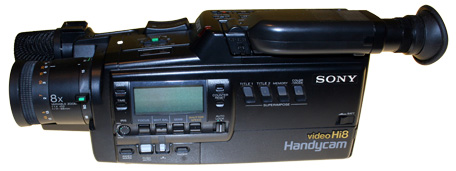
  • Sony CCD-V99 Hi8 Camcorder

    Sony CCD-V99 Hi8 Camcorder

    Manufacturer: Sony

    Model: CCD-V99

    Release Date: May 1989

    MSRP: $2,200

    This is the first Hi8 Handycam Camcorder that was released by Sony.

    It is currently on display at DDVF.